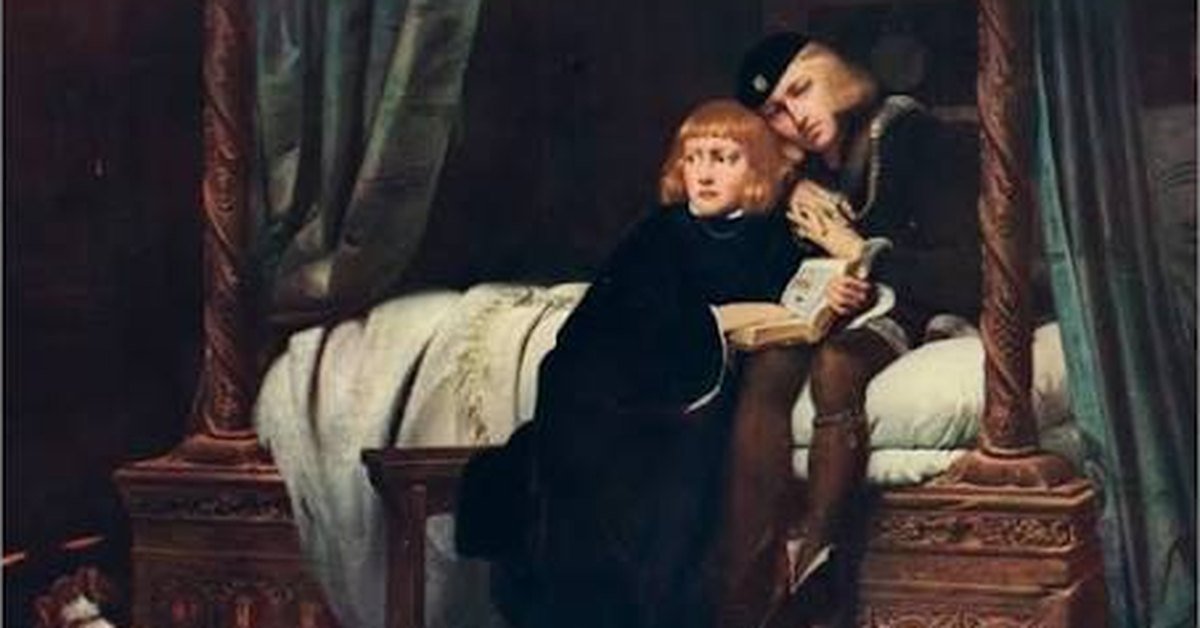
In the summer of 1483, people passing the Tower of London could sometimes see two boys shooting arrows and playing in the gardens. One was twelve. The other was nine. The older boy was, by law, the King of England.
Then they were seen less often. Then only at the windows. Then not at all.
No funeral was held. No announcement was made. Two royal children simply stopped existing in the record, inside the most closely guarded building in the kingdom. More than five centuries later, we still cannot say for certain what happened to them.
A King Dies, a Boy Inherits
On 9 April 1483, King Edward IV died after a short illness. He was only around forty, tall, popular and, until a few weeks earlier, apparently healthy. Nobody had prepared for this.
His crown passed to his eldest son, also named Edward. The boy had been born in November 1470 inside the sanctuary of Westminster Abbey, where his mother had fled during one of the darkest moments of the Wars of the Roses. Now, at twelve, he was King Edward V.
A twelve-year-old cannot rule alone. Someone would have to govern in his name until he grew up. And in fifteenth-century England, whoever held the young king held the kingdom.
Two Boys, Two Very Different Childhoods
The brothers were born into the same family but grew up in different worlds.
Edward was raised as a future king from the start. As a small child he was sent to Ludlow Castle, on the border with Wales, to run his own household. His mother’s brother, Anthony Woodville, Earl Rivers, supervised his education. The young prince followed a strict daily timetable of Mass, lessons, meals and exercise, written out by his father. People who met him described a boy who was bright and well read for his age.
Richard, the younger brother, was born on 17 August 1473 in Shrewsbury. He stayed closer to the court in London. At just four years old he was married in a grand ceremony to Anne Mowbray, a five-year-old heiress, so that her family’s huge fortune would pass to the royal family. Little Anne died in 1481, before either child was old enough for the marriage to mean anything.
The brothers probably spent little time together growing up. The Tower of London may have been the first place they lived side by side in years.
The Uncle and the Tower
The old king had named his younger brother, Richard, Duke of Gloucester, as Lord Protector. Richard was thirty, a proven soldier, and fiercely loyal to Edward IV while he lived.
But the boy king had been raised among his mother’s family, the Woodvilles, and the two sides did not trust each other. As young Edward travelled towards London for his coronation, Richard met the royal party on the road. He arrested the boy’s Woodville uncle and took the king into his own care. Within two months, those arrested men were executed.
On 19 May 1483, Edward was lodged in the royal apartments of the Tower of London. That sounds sinister today, but it was normal at the time. Kings often stayed in the Tower before being crowned.
His mother, Elizabeth Woodville, was frightened enough to flee once again into sanctuary at Westminster Abbey, taking her other children with her. On 16 June, she was persuaded to hand over her younger son, Richard, Duke of York. He was nine years old. He went to join his brother in the Tower.
A Coronation That Never Came
The coronation date came and went. Then, on 22 June, a preacher named Ralph Shaa stood before a crowd in London and made a shocking claim. Edward IV, he said, had been promised in marriage to another woman before he married Elizabeth Woodville. If that was true, the royal marriage was invalid, and all its children were illegitimate.
In one sermon, the boy king lost his right to the throne.
On 25 June, Edward V’s short reign was declared over. He had been king for eleven weeks and was never crowned. On 6 July 1483, in Westminster Abbey, his uncle was crowned King Richard III.
A boy who had been king in April was, by July, officially nobody.
Fading From Sight
One of the few eyewitness accounts comes from Dominic Mancini, an Italian visitor who was in London that year. He wrote that after Richard took power, the princes were moved into the inner rooms of the Tower. They were seen behind the bars and windows less and less, until they stopped appearing altogether.
Mancini also recorded something heartbreaking. The boy king’s doctor, the last of his servants allowed to see him, said that Edward made daily confession and penance, as if he believed death was coming.
A London chronicle mentions the children being seen in the Tower garden during that summer. After that, the trail goes cold. By the autumn of 1483, rumours were spreading across England, and even abroad, that the boys were dead.
Richard’s Uneasy Crown
Richard III had the throne, but he never had peace.
In October 1483, only months after his coronation, a rebellion broke out across southern England. Its leader was a shock: the Duke of Buckingham, the man who had helped Richard take power. The revolt collapsed in bad weather and confusion, and Buckingham was beheaded at Salisbury on 2 November. Many historians believe the rebels had first planned to rescue the princes, then switched to backing a new candidate, a Welsh-born exile named Henry Tudor. If so, that switch suggests the rebels already believed the boys were dead.
In early 1484, Parliament passed an act called Titulus Regius, which set out Richard’s right to rule and repeated the claim that his brother’s children were illegitimate.
Then came one of the most puzzling moments of the whole story. In March 1484, Elizabeth Woodville came out of sanctuary and allowed her daughters to join Richard’s court. Would a mother really make peace with the man who had murdered her sons? Some historians see this as a sign the boys were still alive. Others think she simply had no choice left.
Richard’s own luck ran out quickly. His only son died in April 1484, and his wife died less than a year later. On 22 August 1485, he was killed fighting Henry Tudor at the Battle of Bosworth. He was the last English king to die in battle.
The Suspects
If the princes were murdered, someone gave the order. Historians have argued over three main names for centuries.
Richard III. He had the strongest motive. As long as the boys lived, rebels could rally around them to remove him. They were in his Tower, guarded by his men, and he never produced them alive to silence the rumours. About thirty years later, the writer Thomas More claimed that a knight named Sir James Tyrell had confessed to arranging the killings on Richard’s orders. But More wrote under the Tudors, the family that replaced Richard, and no copy of that confession has ever been found.
Henry Stafford, Duke of Buckingham. He was Richard’s closest ally in 1483, and as Constable of England he could get inside the Tower. Then, in October that year, he suddenly rebelled against Richard and was executed. Some think he removed the princes to clear his own path to the throne, or to damage the king.
Henry Tudor (Henry VII). He defeated and killed Richard at the Battle of Bosworth in 1485 and became king. He then married the princes’ sister, Elizabeth of York. If the boys were still alive somewhere, their claim was stronger than his. His accusers note that he never held a public inquiry into their fate. His defenders reply that he was in exile in Brittany all through 1483, far from the Tower.
The Bones Under the Stairs
For almost two hundred years, the mystery had no bodies. Then, in July 1674, workmen were pulling down an old staircase that led to the chapel of the White Tower. About ten feet down, they found a wooden chest holding the skeletons of two children.
At first the bones were thrown out with the rubble. Then someone remembered Thomas More’s story, which said the princes had been buried at the foot of a stair. The bones were collected again, and King Charles II ordered them placed in Westminster Abbey. In 1678 they were laid to rest in a white marble urn designed by Sir Christopher Wren, in the chapel of Henry VII, the very man some suspect.
In July 1933, the urn was opened and the bones were examined by an archivist and a doctor, Lawrence Tanner and William Wright. They concluded the remains were two children of about the right ages. But the skeletons were incomplete, some animal bones were mixed in, and the science of the time could not tell their sex or even the century they died in.
No modern DNA or carbon-dating tests have ever been allowed on the urn. Until they are, the bones cannot prove the case either way.
The Boy Who Came Back?
The strangest part of the story begins after Richard III was dead.
In 1487, a boy was crowned in Dublin as a Yorkist king. Henry VII’s government said he was a commoner named Lambert Simnel. Then, in the 1490s, a confident young man appeared in Europe claiming to be Richard, Duke of York, the younger prince, saved from the Tower. He was welcomed at foreign courts and treated as royalty.
Henry VII called him Perkin Warbeck, a boatman’s son from Tournai in Flanders. After his capture, he signed a confession saying exactly that. In November 1499, he was hanged at Tyburn.
Was he an impostor, or the real prince? For most of history, the answer seemed obvious. Recently, it has become a serious argument again.
How Shakespeare Made a Villain
Most people who “know” this story learned it from William Shakespeare.
In his play Richard III, written in the early 1590s, Richard is a hunched, scheming monster who murders his way to the crown and openly orders the deaths of his nephews. The play was a huge success, and its version of events stuck in the public imagination for centuries.
But Shakespeare was a dramatist, not a historian. He wrote for an audience ruled by Queen Elizabeth I, the granddaughter of Henry VII, and he drew heavily on Tudor writers such as Thomas More. Making Richard a villain made the Tudors look like rescuers.
Painters kept the legend alive. Paul Delaroche’s 1830 painting shows the frightened brothers huddled on a bed while their little dog stares at the door. John Everett Millais painted them in 1878, standing together in the dark at the foot of a stair. These images are so powerful that many people picture the princes exactly that way today.
In 1924, a group of enthusiasts founded what became the Richard III Society to argue that the king had been unfairly judged. The society still exists, and its members were among those behind the search that found his grave in 2012.
Still an Open Case
In 2023, Philippa Langley, the researcher who led the search that found Richard III’s grave under a Leicester car park, published the results of her Missing Princes Project. Hundreds of volunteers had searched archives across Europe. Langley argues that the documents they found point to both princes surviving, and to the so-called impostors being the real boys.
Not everyone agrees. Other historians have challenged her readings in academic journals, arguing that papers written for a pretender would say these things whether he was genuine or not. The debate is now louder than it has been in decades.
So where does that leave us? Two children went into the Tower in 1483. Their uncle took the throne. Two small skeletons were found under a stair, and two young men later claimed to be the missing boys. Every piece of evidence can be read more than one way.
Perhaps one day the urn in Westminster Abbey will be opened again and modern science will give the princes back their names. Until then, they remain what they have been for over five hundred years: the most famous missing children in royal history.
What do you think happened to the princes? Tell us in the comments.
Timeline at a Glance
| Date | Event |
|---|---|
| 2 Nov 1470 | Edward born in sanctuary at Westminster Abbey |
| 17 Aug 1473 | Richard born in Shrewsbury |
| 9 Apr 1483 | Edward IV dies; Edward V becomes king at 12 |
| 19 May 1483 | Edward V lodged in the Tower of London |
| 16 Jun 1483 | Richard, Duke of York, joins his brother in the Tower |
| 25 Jun 1483 | Edward V’s reign declared over |
| 6 Jul 1483 | Richard III crowned |
| Summer 1483 | Last reported sightings of the princes |
| Oct–Nov 1483 | Buckingham’s rebellion fails; Buckingham executed |
| 22 Aug 1485 | Richard III killed at Bosworth; Henry VII becomes king |
| Nov 1499 | “Perkin Warbeck” hanged at Tyburn |
| 17 Jul 1674 | Two children’s skeletons found at the Tower |
| 1678 | Bones placed in an urn in Westminster Abbey |
| Jul 1933 | Urn opened and bones examined |
| 2023 | Missing Princes Project publishes its findings |
Frequently Asked Questions
Who were the Princes in the Tower?
They were Edward V of England and his younger brother Richard, Duke of York, the two sons of King Edward IV and Elizabeth Woodville.
How old were the princes when they disappeared?
Edward was 12 and Richard was 9 in the summer of 1483, when they were last reported alive.
Did Richard III kill the princes?
He is the traditional and most popular suspect, and he had the strongest motive. But there is no confession, no body proven to be theirs, and no document that settles it.
Where are the bones of the princes now?
The bones found in 1674 rest in a marble urn in Henry VII’s Chapel in Westminster Abbey. They have never been DNA tested, so we cannot be sure they are the princes.
Was Perkin Warbeck really Prince Richard?
Henry VII said he was a Flemish boatman’s son, and most historians have agreed. Recent research has reopened the question, but it remains hotly disputed.
Sources and Further Reading
- Westminster Abbey: Edward V and Richard, Duke of York
- Historic UK: The Princes in the Tower
- History Hit: The Princes in the Tower, Solving History’s Greatest Cold Case
- Richard III Society: The bones from the Tower
- Historical Research: Historic doubts about the survival of the Princes in the Tower after 1485